10 Essential Tips for Choosing Long Range Walkie Talkies?
In an increasingly connected world, Long Range Walkie Talkies play a crucial role in communication. According to a 2022 market report, the walkie talkie market is projected to reach $5 billion by 2027, driven by growing demand in various sectors like construction, security, and outdoor recreation. As outdoor enthusiasts seek reliable communication devices, understanding how to choose the right model becomes essential.
When selecting Long Range Walkie Talkies, consider factors such as range, battery life, and durability. Many users overlook these elements, leading to disappointment in performance. For instance, a good walkie talkie should have a range of at least 25 miles in open terrain, but this drops significantly in urban areas. Reports indicate that battery performance varies, with poor choices causing breakdowns during critical moments.
It's clear that purchasing Long Range Walkie Talkies requires thorough research and understanding. Comprehensive reviews can help; however, user experiences often differ from expectations. Familiarizing yourself with features, user feedback, and potential limitations can guide better decisions, ensuring that the communication remains uninterrupted in every adventure.
Understanding the Range: Factors Affecting Walkie Talkie Distance
When choosing long range walkie talkies, understanding the range and its influencing factors is vital. Range is not just about power; it’s influenced by terrain, frequency, and conditions. According to industry reports, open areas can allow signals to travel up to 30 miles. However, in urban settings or densely forested regions, the effective range often drops to just a few miles.
Obstacles like buildings, trees, and hills can interfere with signal clarity. The type of frequency also matters. UHF frequencies typically perform better in urban areas due to their ability to penetrate walls, while VHF is often favored in open spaces. A study indicated that for every 1,000 feet of elevation, range may increase by about 20%. This emphasizes the importance of selecting the right location for optimal communication.
It’s essential to consider the power output too. Many walkie talkies use 0.5 to 5 watts. Devices with higher wattage can transmit over longer distances. Still, they often drain batteries quickly, potentially leaving users disconnected when they need it most. Recognizing these factors and how they interact can help in making a well-informed choice.
10 Essential Tips for Choosing Long Range Walkie Talkies
This chart illustrates the various factors affecting the effective range of walkie talkies, represented by the maximum range in miles for different environmental conditions.
Frequency Bands: Choosing Between UHF and VHF for Long Range Use
When choosing long-range walkie-talkies, frequency bands matter greatly. UHF (Ultra High Frequency) and VHF (Very High Frequency) each have unique characteristics. UHF operates from 400 to 512 MHz, while VHF ranges from 30 to 300 MHz. UHF signals can penetrate obstacles better, making them ideal for urban environments. In contrast, VHF tends to travel farther over open spaces due to lower frequency waves.
Studies show that UHF radios often outperform VHF radios in built-up areas. A report by the National Telecommunications and Information Administration indicated that UHF communication can maintain clarity in environments with tall buildings. However, VHF systems can achieve longer ranges in rural areas. They can easily cover distances up to 65 miles under optimal conditions. This distinction is crucial for users needing reliable communication over varying terrains.
Choosing between UHF and VHF also involves considering user requirements. If you need to communicate within a city, UHF is often preferred. If you’re in open fields or mountains, VHF might be better. However, interference and factors like weather can impact performance. Each environment presents challenges. User feedback often points out the nuances. Understanding these differences helps ensure the right decision, especially when communication relies heavily on reliability.
10 Essential Tips for Choosing Long Range Walkie Talkies
| Tip Number |
Tip Description |
Frequency Bands |
Range |
| 1 |
Consider the purpose of use (hiking, construction, etc.) |
UHF |
up to 20 miles |
| 2 |
Check battery life and type |
VHF |
up to 10 miles |
| 3 |
Look for models with NOAA weather alerts |
UHF/VHF |
Variable depending on terrain |
| 4 |
Ensure the walkie talkie is waterproof or weather-resistant |
UHF |
up to 15 miles |
| 5 |
Choose a lightweight and portable design |
VHF |
up to 12 miles |
| 6 |
Look for additional features like VOX (voice activation) |
UHF |
up to 18 miles |
| 7 |
Consider range in urban versus rural areas |
VHF |
up to 8 miles in urban |
| 8 |
Check for programmable channels |
UHF/VHF |
up to 22 miles |
| 9 |
Evaluate the ease of use and interface |
UHF |
up to 10 miles |
| 10 |
Read customer reviews for practical insights |
VHF |
up to 5 miles |
Battery Life Considerations: Importance of Power Sources for Longevity
When choosing long-range walkie-talkies, battery life is a crucial consideration. The type of power source impacts longevity significantly. Some devices use disposable batteries, while others rely on rechargeable options. Disposable batteries might provide convenience initially but can become expensive over time. Rechargeable batteries, although they require access to a power source, often offer more sustainable usage in the long run.
It's essential to evaluate how frequently you intend to use the devices. If you're on a long hike or a weekend camping trip, long battery life is vital. Consider models with energy-efficient features. This can extend your usage time significantly. However, don’t overlook the potential for battery degradation over time, especially for rechargeable units. Regular maintenance and periodic replacements are necessary to keep them in optimal condition.
Reflect on your specific needs. Do you need a walkie-talkie that lasts for days without a recharge? Or will you have access to power sources during your adventures? Balance between performance and practicality. Think about how often you find yourself in areas without easy access to charging stations. The right choice can make or break your communication experience.
Durability and Build Quality: Selecting Walkie Talkies for Rugged Environments
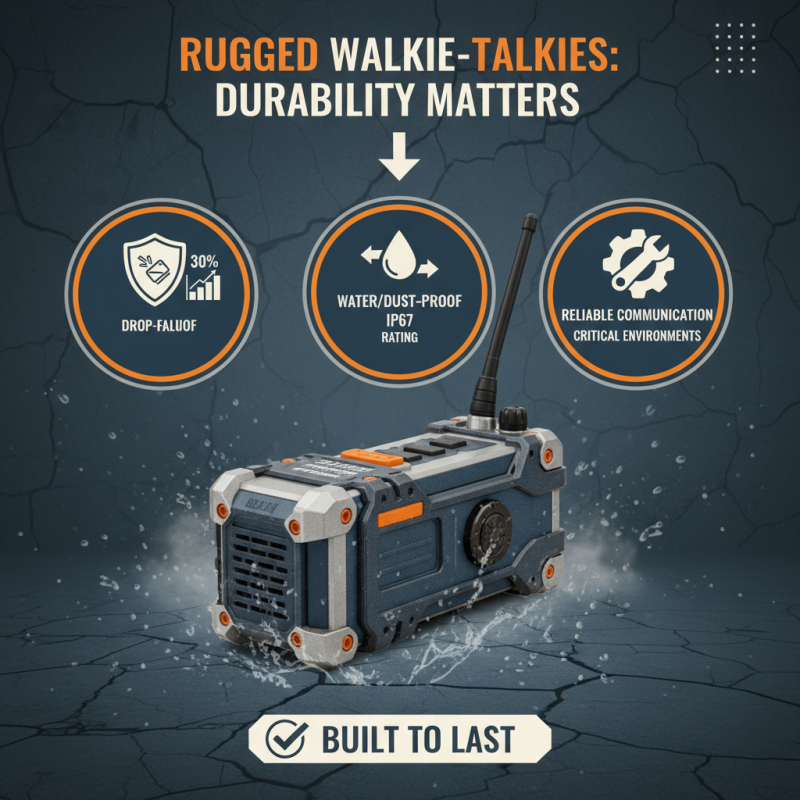
Selecting walkie talkies for rugged environments demands careful consideration of durability and build quality. These devices often face harsh conditions. Reports show that over 30% of communication failures stem from equipment damage. Thus, choosing models designed to withstand drops, water, and dust is vital.
Tip: Look for walkie talkies with high IP ratings. An IP67 rating means they are dust-tight and can handle submersion in water for short periods. This feature is essential for outdoor activities like hiking or construction work.
Material choice is also crucial. Many durable walkie talkies use reinforced plastics or metals to enhance resilience. Studies indicate that devices with solid frames can survive falls of up to six feet. Still, some users might find that even robust models can show wear over time.
Tip: Test the grip and comfort of walkie talkies. A secure hold is necessary when navigating rough terrain. Be mindful that heavy-duty models may feel bulkier, which can affect usability. Balancing sturdiness with ease of handling can lead to better long-range communication in demanding scenarios.
Extra Features: Evaluating Additional Functions for Enhanced Communication
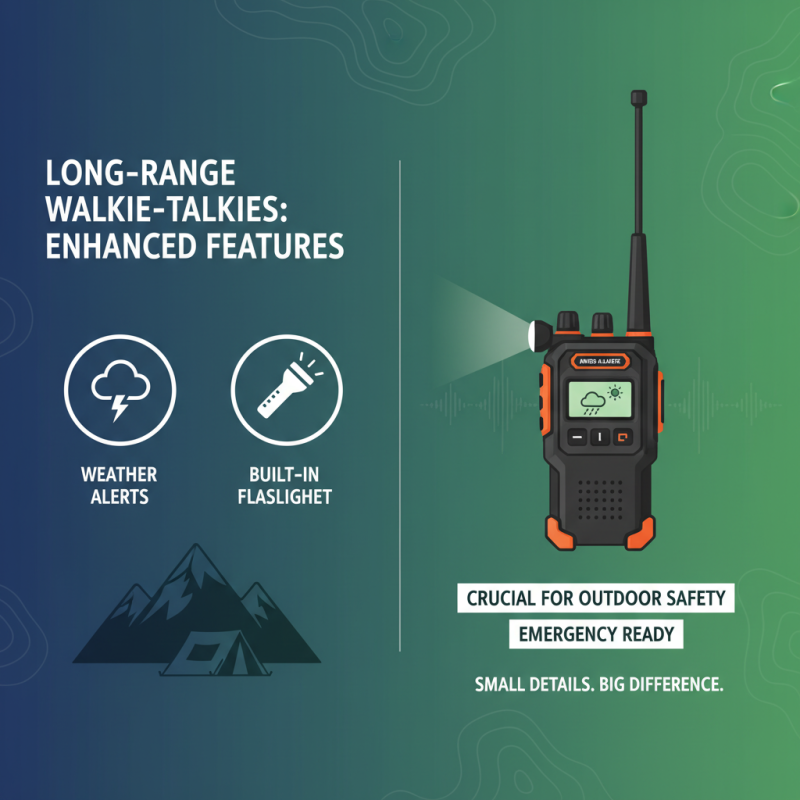
When selecting long-range walkie-talkies, consider extra features that can significantly improve communication. For instance, some models offer weather alerts. This can be lifesaving during outdoor adventures. Additionally, a built-in flashlight might seem unnecessary, but it can be vital in emergencies. Small details matter when you're in the wild or during power outages.
Another useful function is the ability to connect with multiple channels. This feature allows teamwork among large groups. However, it may complicate usage for some. Not everyone needs multiple channels, so evaluate your specific needs. Battery life is crucial too. Some models claim long-lasting power, but real-life usage can vary. Always think about whether you need a detachable battery or solar charging.
Noise-canceling technology is also noteworthy. It helps in crowded environments. Still, if you find it reduces voice clarity, consider other options. There's no perfect solution out there. Weighing the pros and cons of each feature is key. Finding the right balance is what truly enhances communication.