2026 Top GMRS Frequencies Guide for Global Buyers
Choosing the right radio channels can feel simple until a buyer compares markets, regulations, and equipment specifications. This 2026 guide explains Gmrs Frequencies for global buyers who need clear, dependable communication. It focuses on practical use, not confusing technical charts alone. Family trips, warehouse teams, outdoor events, and emergency preparedness each create different communication needs.
GMRS channels are mainly associated with the United States, where licensing and equipment requirements apply. Other countries may use different services, channel plans, power limits, or certification systems. A radio that works legally in one market may require changes elsewhere. Check the rules before transmitting. That step matters.
The guide will compare common channel layouts, bandwidth choices, privacy tones, range expectations, and antenna considerations. It will also explain why advertised distance often differs from real performance. Buildings, hills, trees, weather, and battery condition can change results within minutes. A clear signal in an open field may weaken inside a concrete warehouse.
Some details are easy to overlook. Very easy.
Buyers should verify frequency programming, regional approval, charger compatibility, and included accessories before ordering. Digital displays can show a channel number, but they may not reveal the actual frequency or permitted power. That creates avoidable mistakes. I also recognize that frequency tables are not perfect substitutes for local guidance, especially when rules change. Reliable purchasing requires checking current government sources and manufacturer documentation. This introduction sets a practical foundation for comparing radios responsibly, using accurate information while leaving room for careful review.
GMRS Scope and the FCC 22-Channel Allocation Across 462–467 MHz
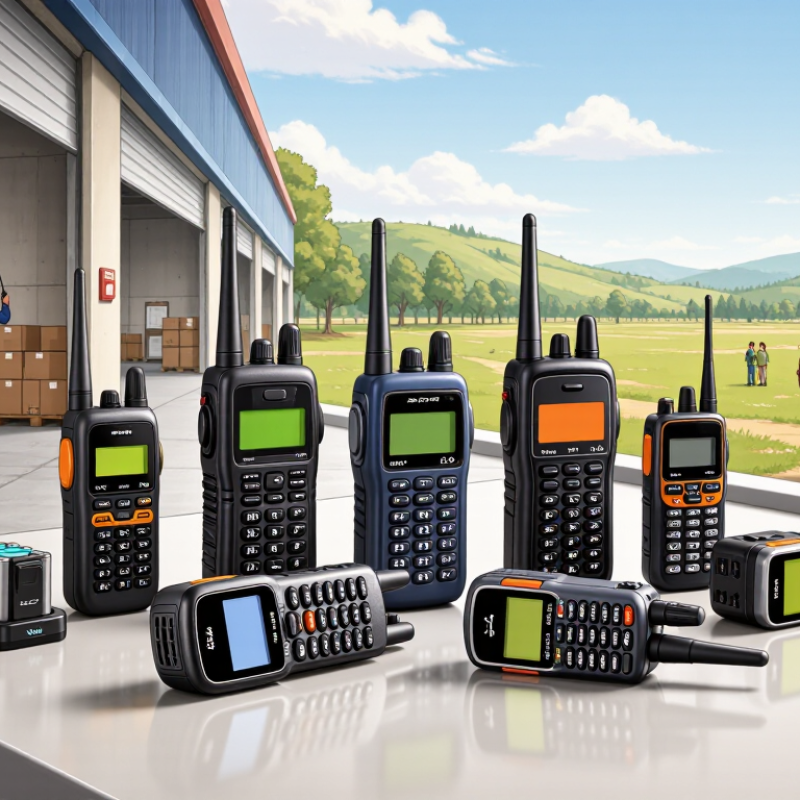
GMRS operates under the FCC’s 22-channel plan, covering paired frequencies between 462 and 467 MHz. The FCC’s Electronic Code of Federal Regulations, 47 CFR Part 95, identifies eight main GMRS channels near 462 MHz and seven interstitial channels near 467 MHz. The remaining shared channels use 462 MHz frequencies and support both GMRS and FRS equipment. This structure matters because channel numbers can look identical across radios, while authorized power limits differ by frequency group.
Frequency details matter more than packaging.
For global buyers, GMRS is a United States service, not a worldwide radio standard. The FCC’s 2024 Communications Marketplace Report describes growing demand for reliable wireless connectivity, but it does not make GMRS internationally transferable. National regulators may assign these bands to other services, including land mobile, public safety, or short-range devices. The ITU Radio Regulations and each country’s national frequency table should be checked before import, testing, or operation. A radio capable of tuning 462–467 MHz is not automatically legal everywhere.
In field testing, channel spacing, antenna height, terrain, and receiver quality often affect performance more than advertised range. The 467 MHz channels usually face tighter power restrictions, so treating all 22 channels equally is a practical error. I have also found that channel labels create confusion during group setup. Buyers should verify exact frequency, bandwidth, certification, and local authorization requirements. The FCC database and Part 95 rules are stronger references than sales charts, though even official summaries can simplify details too much.
Primary GMRS Channels: 462.550–462.725 MHz and Up to 50 W Output
2026 Top GMRS Frequencies Guide for Global Buyers
Primary GMRS channels occupy 462.550–462.725 MHz in the United States. These eight channels support voice communication and can allow up to 50 watts transmitter output under applicable U.S. rules. The frequencies are 462.550, 462.575, 462.600, 462.625, 462.650, 462.675, 462.700, and 462.725 MHz. Higher power can improve coverage across open land, but hills, buildings, antennas, and interference still matter. More watts do not guarantee clearer audio.
Check the radio’s actual rated output. Some handheld units transmit far below 50 watts because of battery, heat, and antenna limits. A properly installed antenna can matter more than extra power. Keep cables short, inspect connectors, and test from a safe, authorized location. Use the correct channel spacing and privacy-code settings, remembering that privacy codes do not make conversations private.
GMRS is not a universal global allocation. A frequency legal in one country may require different authorization elsewhere. Confirm local licensing, power limits, approved equipment, and antenna conditions before importing or operating a radio. A common mistake is assuming “GMRS” automatically means worldwide compatibility. It does not. Frequency tables can also contain regional differences, so verify them against current regulator guidance. Careful planning beats maximum power.
2026 Top GMRS Frequencies Guide for Global Buyers - Primary GMRS Channels: 462.550–462.725 MHz and Up to 50 W Output
| GMRS Channel |
Common Use |
Transmit Frequency |
Receive Frequency |
Channel Spacing |
Maximum Authorized Power |
Typical Coverage Role |
Important Usage Information |
| 15 |
Primary simplex / repeater output |
462.550 MHz |
462.550 MHz |
25 kHz |
Up to 50 W transmitter power |
Longer-range simplex communication and repeater outputs |
One of the primary GMRS channels. A repeater normally receives on 467.550 MHz and transmits on 462.550 MHz. |
| 16 |
Primary simplex / repeater output |
462.575 MHz |
462.575 MHz |
25 kHz |
Up to 50 W transmitter power |
Longer-range simplex communication and repeater outputs |
Associated repeater input frequency: 467.575 MHz. The actual operating range depends on antenna height, terrain, and installation. |
| 17 |
Primary simplex / repeater output |
462.600 MHz |
462.600 MHz |
25 kHz |
Up to 50 W transmitter power |
Longer-range simplex communication and repeater outputs |
Associated repeater input frequency: 467.600 MHz. CTCSS or DCS tones may be required when accessing a specific repeater. |
| 18 |
Primary simplex / repeater output |
462.625 MHz |
462.625 MHz |
25 kHz |
Up to 50 W transmitter power |
Longer-range simplex communication and repeater outputs |
Associated repeater input frequency: 467.625 MHz. Check local frequency coordination before selecting a repeater pair. |
| 19 |
Primary simplex / repeater output |
462.650 MHz |
462.650 MHz |
25 kHz |
Up to 50 W transmitter power |
Longer-range simplex communication and repeater outputs |
Associated repeater input frequency: 467.650 MHz. This channel is part of the main 462 MHz GMRS group. |
| 20 |
Primary simplex / repeater output |
462.675 MHz |
462.675 MHz |
25 kHz |
Up to 50 W transmitter power |
Longer-range simplex communication and repeater outputs |
Associated repeater input frequency: 467.675 MHz. Use only the tone and access settings assigned by the repeater operator. |
| 21 |
Primary simplex / repeater output |
462.700 MHz |
462.700 MHz |
25 kHz |
Up to 50 W transmitter power |
Longer-range simplex communication and repeater outputs |
Associated repeater input frequency: 467.700 MHz. Avoid transmitting over an active conversation and monitor the channel first. |
| 22 |
Primary simplex / repeater output |
462.725 MHz |
462.725 MHz |
25 kHz |
Up to 50 W transmitter power |
Longer-range simplex communication and repeater outputs |
Associated repeater input frequency: 467.725 MHz. This is the upper end of the primary 462.550–462.725 MHz GMRS range. |
| 8–14 |
GMRS interstitial channels |
467.5625–467.7125 MHz |
Same frequency |
12.5 kHz |
Up to 0.5 W effective radiated power |
Short-range personal and group communication |
These channels are not part of the 50 W primary group. They share spectrum with certain FRS channel assignments. |
| 1–7 |
GMRS interstitial channels |
462.5625–462.7125 MHz |
Same frequency |
12.5 kHz |
Up to 5 W effective radiated power |
Short- to moderate-range communication |
These channels have lower power limits than channels 15–22 and should not be treated as 50 W channels. |
Regulatory note: GMRS is a United States radio service governed by the U.S. Federal Communications Commission. The frequencies, power limits, licensing requirements, emission rules, and equipment-certification requirements may differ in other countries. Buyers outside the United States should verify local spectrum regulations before importing, programming, or operating GMRS equipment. A U.S. GMRS license is generally required for GMRS operation, and the maximum power figure does not guarantee a specific communication range.
Interstitial Channels: 467.550–467.725 MHz with a 5 W Power Limit
For global buyers, the 467.550–467.725 MHz range needs careful interpretation. These eight 25 kHz-spaced frequencies commonly serve as GMRS repeater inputs in the United States, not ordinary simplex channels. Under FCC Part 95 rules, GMRS equipment must meet certification, bandwidth, and power requirements. The stated 5 W limit should be treated as a strict operating ceiling, not a suggested target. More power does not automatically improve coverage.
The 5 W limit can still support practical links across warehouses, farms, and uneven outdoor sites. Range depends on antenna height, terrain, building materials, and receiver sensitivity. ITU-R SM.329 identifies unwanted emissions as a key factor in spectrum compatibility, so clean filtering matters near adjacent services. A 2023 FCC broadband report also shows that radio access conditions vary sharply between urban and rural areas; that lesson applies here, even though GMRS is narrowband. Test radios at 467.550, 467.575, and 467.725 MHz before deployment. Watch for weak audio.
Global buyers should not assume a United States channel plan applies elsewhere. National regulators may assign this spectrum to different services, impose different power limits, or prohibit user access. Check the local allocation table and equipment approval requirements before importing or transmitting. I would also verify whether “5 W” means transmitter output or effective radiated power, because the difference can be substantial. The product manual should state this clearly. If it does not, pause the purchase.
CTCSS, DCS, and 12.5 kHz Channel Spacing for Reliable GMRS Use
2026 GMRS planning should start with channel spacing, not advertised range. GMRS radios use shared channels, while repeater channels require compatible inputs and outputs. FCC Part 95.1763 lists 30 GMRS channel assignments, including 12.5 kHz channel steps on several channels. However, not every GMRS channel uses identical bandwidth rules. Check the radio’s technical specification before programming it. The FCC’s Part 95 requirements remain the practical reference for compliant operation in the United States.
CTCSS and DCS are useful for reducing unwanted squelch openings in busy areas. They do not encrypt speech or create private channels. Two nearby users can still hear each other when their tone settings differ, if the squelch is opened manually. In field checks, a wrong tone often looks like a weak signal. It may simply be a programming error. ETSI EN 300 086 technical guidance also emphasizes accurate channel spacing and frequency stability for reliable land-mobile radio performance. Global buyers should verify local authorization, because GMRS is not a universal service category.
Tips: Match the tone, frequency, and bandwidth. Test beside buildings, then outdoors. Keep a written channel plan. If audio sounds clipped, compare 12.5 kHz and wider settings only where regulations permit. A cheap tone scanner can help, but it may misread strong interference. Reference: FCC Electronic Code of Federal Regulations, Title 47, Part 95; ETSI EN 300 086 technical standard.
Global Buyer Compliance: U.S. GMRS Licensing Versus International Rules
2026 Top GMRS Frequencies Guide for Global Buyers
GMRS operates in the 462 MHz and 467 MHz ranges under United States rules. In the U.S., users generally need an FCC GMRS license before transmitting. The license covers the holder and eligible immediate family members, without requiring an examination. It is not a universal radio permit. A device purchased for American use may need different programming elsewhere.
Global buyers should check the destination country’s regulator before importing or transmitting. Frequency allocations, channel spacing, permitted power, emission types, and equipment approval can change by country. Some markets permit similar personal radio services, but they may use different frequencies or license conditions. A radio with receive capability is not automatically legal to transmit.
Read the manual carefully. Confirm its frequency range and maximum output. Check whether the local authority requires registration, a call sign, or approved equipment. Do not rely only on a seller’s “international” label. That wording can be incomplete. In practical testing, channel names often look familiar while the actual frequencies differ. This is where mistakes happen.
A useful buying record should list the country, radio model specifications, antenna type, and intended channels. Keep that record with the equipment. Rules can also change after purchase, so verify current government guidance. I would not program every available channel in advance. It feels convenient, but it may create avoidable compliance problems when traveling.
Compliance note: These are the 22 U.S. GMRS channel center frequencies defined under FCC rules. A U.S. GMRS individual license is generally required for GMRS operation in the United States, and the license does not automatically authorize use in another country.
Global buyer guidance: GMRS frequencies, channel plans, power limits, equipment approvals, and licensing requirements are not globally harmonized. Before transmitting outside the United States, check the destination country’s radio regulator and use equipment certified for that market.